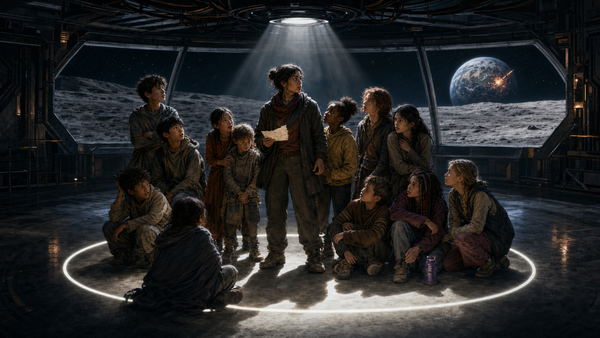
Mars, Regrettably Correct
In this Earthfall story, Leila Haddad faces a biological emergency that forces Mars to use Ceres material without turning care into ownership.

Leila Haddad had full warehouses, failing renewal and one package intended for somebody else. I had an opinion. Only one of us improved the record.
The Earthfall Record · EF-S06 · Northern Mid-Latitude Agricultural Region, Mars
• • •
HelioPress asked me for a short account of why Mars opened the Ceres package. The word why is dangerous. It sits in a sentence looking harmless while inviting motive, necessity, authority, blame, weather, childhood, politics and whichever moral conclusion the reader had prepared before arriving.
Historians prefer what information was available when the seal was broken. Publishers say this is less attractive on a contents page and have declined my suggestion that readers improve.
My first sentence was:
Mars took material promised to Ceres because Mars considered its emergency more important.
This sentence is concise. It is also unsupported in three separate places, overconfident in a fourth and personally satisfying, which should have alerted me sooner. I deleted it.
My second sentence was:
Martian authorities authorised minimum represented use of two components after a crop-system fault reduced local renewal horizons below the safe interval.
This sentence is accurate. It has the additional virtue of causing the human eye to seek an exit. I retained both in the correction layer and went to make tea.
The machine produced water at the correct temperature and tea at the wrong one. This distinction has survived six maintenance visits. The dispenser is not broken. It is simply committed to a result outside the declared standard, which gives it more in common with government than Facilities appreciates.
When I returned, Yeva was in my office examining Unreliable Witness.
“Don’t,” I said.
“I’m looking.”
“Professionally.”
“Rupert, it has fungus.”
“That conclusion remains under review.”
She held up a leaf whose position was difficult to defend. It had gone grey at the edge and soft through the middle, a condition even I could not plausibly reclassify as autumn because Ceres has the good sense not to manufacture seasons in offices.
Yeva works with seed banks and crop diversity. She knows the difference between preserving a sample and preserving the capacity to grow from it. I know this difference too, in the way historians know many things they would prefer not to have applied near their desks.
She read my two opening sentences. “Which one do you believe?”
“Belief is not the field under review.”
“That one, then.”
She indicated the first and began clearing space around the plant, which is how Yeva conducts an argument when the evidence has roots.
• • •
After Earthfall, the Northern Mid-Latitude Agricultural Region on Mars still had full warehouses. The phrase appears in inventory summaries and later in political speeches, where full expands to fill any gap in the argument. Four hundred and eighteen litres of working suspension. Retained seed lines. Nutrient stores. Culture stocks. Redundant environmental loops. All present. All counted.
Leila Haddad asked what renewed them.
Leila was Mars-born, a crop-pathology diagnostician, and professionally impatient with inventories written entirely in the present tense. A warehouse could be full on the day its future disappeared. A culture could remain available after its ability to reproduce had fallen below demand. A crop line could look healthy across a field whose replacement cycle was already lost.
Abundance is not a quantity. It is a quantity with time attached. Leila added renewal horizons to the Martian counts, and the result was impolite.
Several stores remained large. Their verified replacement intervals did not. Some biological lines had parent material but no safe expansion path. Others had working suspension without reliable renewal. Temperature excursions existed in the logs as acknowledged alarms whose consequences had never been joined into one system.
No single official had hidden the danger. Each local record was correct. Together they described a future nobody had filed, which is one of civilisation’s preferred methods of being surprised.
Leila began with the crop-system fault rather than the politics. She traced storage, field performance, compatible lines and environmental history. She separated what was failing from what merely looked similar. She rejected broad claims that would have turned one regional diagnosis into a Martian condition.
This was good work. I distrusted it at once. The distrust was not produced by the work.
I include that distinction because prejudice often enters the archive dressed as methodological caution. It asks excellent questions of the people it dislikes and accepts approximate answers from everybody else. I put Leila’s assumptions through three reconstructions, checked the alarms against storage history and searched for the bit where Mars became conveniently incompetent.
There was no bit.
“Oh, do fuck off,” I told the record.
The record retained this statement but did not treat it as peer review. Leila’s answers survived. Mine did not.
• • •
The Ceres continuity package had left Luna aboard Godwit after the first rescue. It was not a gift to Mars. It was not Martian property. It was also not an untouchable relic whose moral cleanliness could feed a settlement.
The package carried biological references and capability intended for Ceres, already burdened by the altered rescue state. By the time Godwit reached Mars, its declared purpose, physical contents, custody and future use had become four different arguments travelling in one hold.
Mars offered safe harbour. Safe harbour required berth time, labour, habitat displacement, quarantine and risk. Kito Mensah, the Phobos berth steward, recorded those costs without converting them into title. Sarai Nwosu, a Northern Lowland jurist, kept Earth’s surviving claims audible without allowing an authenticated voice to become automatic command over Martian machinery.
Leila dealt with the part that might die. The local parent lot remained sealed. That matters.
Opening it might have produced a broader test and consumed the material needed to reproduce the result. Leila instead narrowed the question until the minimum represented use could answer it. One Ceres assay reference. One compatible culture cassette. Two red use histories. Four Ceres frames remained green, sealed and unspent.
The test traced the fault. It did not make Mars biologically secure, prove universal compatibility, turn the opened material into Martian property or convert the action into something Ceres had consented to. It established a bounded diagnostic result under an emergency in which refusing to use available material also had consequences.
This is the second difficulty in explaining Earthfall: restraint may still consume the irreplaceable thing.
Leila used as little as the evidence allowed. The amount was not zero. This is a fact that irritates moral absolutists on both sides, which does not make it less of a fact.
• • •
“You’ve overwatered it,” Yeva said. We had returned, unfortunately, to the rosemary.
“I followed the cultivation record.”
“Which one?”
I indicated the file. She opened the revision history. There were nine instructions.
The oldest assumed a different substrate. The next three copied it without the substrate field. A later version adjusted the lighting interval. Two conflicting water schedules had been consolidated into a single confident number by a household assistant I had trusted because it used a table.
The plant had been drowning in well-documented compliance. Yeva waited with both hands resting beside the growth sleeve. She does not rush silence. This is useful in seed work and devastating in domestic disputes.
“The instructions agreed,” I said.
“Because they copied one another.”
“Yes.”
“And the measured state?”
“Fungal.”
“Good. We’re making progress.”
She removed the saturated growth sleeve, wrapped the root block and set it beside the lamp.
“Have you got a replacement line?” I asked.
“Of course.”
“Then the plant is not irreplaceable.”
“This plant is.”
I dislike it when seed-bank technicians become philosophical. They have physical custody of the metaphors.
Yeva pointed towards the Leila Haddad record.
“Full stores?”
“Yes.”
“Renewal?”
“Insufficient.”
“Usable external reference?”
“Present, but promised onward.”
“Minimum test?”
“Two represented components.”
“Substitute?”
“Possible. Lower throughput. Higher burden. Not equivalent.”
“And the people?”
I looked at the regional failure horizon.
There is a point in every evidentiary argument when the nouns recover their bodies. Working suspension becomes crop output. Crop output becomes food. Food becomes children, technicians, patients, people who have never heard of Ceres and do not become less hungry because the correct owner of a cartridge is elsewhere.
“At risk,” I said.
Yeva nodded and began cutting dead root tissue from the rosemary with a blade narrow enough to make the work look gentle. She did not tell me what conclusion to reach. She rarely does when the facts have already arrived and I am the remaining delay.
• • •
The Martian substitute took forty days to prepare. It travelled as a substitute, not an equivalent. This wording was fought over because institutions enjoy the word equivalent. It permits a used obligation to return wearing a clean label. Leila refused it.
The substitute had lower throughput and imposed a higher burden on Ceres. It required more power, more cleaning, more calibration and more skilled attention. Those are not footnotes to capability. They are the people standing beside it at the end of a shift.
She preserved the protocols, uncertainty, retained lines and test history. The original use remained visible. The Ceres-bound record did not say that the package had been restored. It said what had been opened, what had been learned, what remained sealed and what the replacement could not do as well.
This is not repayment. It is accountable transfer. Ceres was still entitled to object, and Mars sent the objection with the cargo.
The Godwit departure state at E plus 272 days contained four sealed original frames, two red use histories, one Martian substitute, two protected archive copies and twenty-three people. The trajectory held forty-six kilograms of certified mass margin after uncertainty.
Later summaries call this spare capacity. A kilogram cannot become air, consent, throughput or a berth because a commemorative writer dislikes an untidy ending.
The ship left for Ceres. Mars restored the maintenance habitat displaced from its berth to first priority.
Leila’s crop work continued beyond the clean edge of the story, because biological recovery does not respect chapter architecture and has never once asked whether the reader would prefer closure.
• • •
My anti-Martian prejudice is irrational. It is unsupported by the public record and repeatedly defeated by competent Martian action.
Readers sometimes assume this means I am pretending to dislike Mars for comic effect. I am not. Other readers assume there must be a historical argument hidden inside the hostility which, when revealed, will show that I was correct in a deeper and more interesting way. There is not.
A prejudice may have a cause without having a defence. The cause is private. The failure is public.
The Martian record is particularly inconsiderate because it will not even supply the comfort of consistent villainy. Martian officials make errors. They protect institutions. They use language strategically. They also run careful traffic, preserve objections, calculate honest limits and correct labels that would benefit them if left alone.
Leila Haddad is worse. She is exact in the places where I would prefer her to be careless. She distinguishes full inventory from renewable capacity, opens the smallest represented amount, keeps the parent lot sealed, refuses equivalence and sends the burden onward with the benefit.
One cannot build a respectable planetary grievance under these conditions. I have tried. The foundation keeps passing inspection.
• • •
At 15:22 HelioPress returned my revised opening. I had written:
Mars used two Ceres-bound components during a documented biological emergency, preserved the use and objection, and sent a non-equivalent substitute onward.
The editor’s note said:
Accurate. Where is the person?
Editors are paid to ask this after cutting the paragraph in which one supplied the person. I added Leila in the laboratory, refusing to open the local parent lot; the field count that looked abundant until she attached time; Kito restoring the displaced maintenance habitat to first priority; Sarai preserving Ceres’s right to object; and the twenty-three people aboard Godwit, carrying a solution that had already been somebody else’s loss.
The account was no longer short. It was, however, inhabited.
HelioPress regards length as an ethical boundary when printers are involved and an artistic concern when historians are. We reached an agreement under which they would publish the piece and I would stop describing the requested reduction as evidence destruction.
I did not agree that it was not evidence destruction. I merely stopped describing it that way in messages, which HelioPress accepted as professional development.
Yeva replanted Unreliable Witness in a dry sleeve. Loose substrate clung to her fingers and one clipped root lay on the desk between my two opening sentences.
“Will it live?” I asked.
“I don’t know.”
“But you changed the substrate.”
“Yes.”
“Removed the damaged roots.”
“Yes.”
“You have a replacement line.”
“Yes.”
“Can you give me a probability?”
She looked at me. I heard Tove’s diagnostic symbol in the silence.
“No,” Yeva said.
We placed the plant back beneath its light. It looked diminished, corrected and faintly offended. I understood the feeling.
• • •
The title of this account was not mine. I proposed Minimum Represented Use and the Martian Renewal Horizon. HelioPress proposed What Mars Took. We rejected one another’s titles on equal and opposite grounds.
The published title came from Tove, who read the argument over dinner and asked why I did not simply call it Mars, Regrettably Correct.
“Because correct is too broad,” I said.
“Were they wrong about the crops?”
“No.”
“Were they wrong about opening the things?”
“The authority remains disputed.”
“Did opening them work?”
“Within the stated diagnostic limit.”
“Did they lie about replacing them?”
“No.”
“So regrettably correct.”
Yeva continued eating. She had the expression of a person who had reached this conclusion several hours earlier and declined to invoice us for the delay.
I recorded that the title had originated outside HelioPress, which is how one preserves dignity after losing custody of it.
The next morning, Unreliable Witness had lifted one branch. This did not prove recovery. It proved one branch had lifted. I photographed it, logged the changed state and resisted writing anything further for almost four minutes.
Then I added the final line.
Mars had not returned what it received. It had returned the truth about what survival had required.
Regrettably, the distinction was correct.
— R.C. Fenwick
Ceres Knowledge Archive
As of the last correction