Please Begin with the End of the World
Please Begin with the End of the World follows Rupert Fenwick as he tries to explain Earthfall in 300 words—until his daughter finds the one detail that matters.
In which an eleven-year-old asks a short question, a historian gives several longer ones, and Earthfall proves resistant to homework.
The Earthfall Record · EF-S04 · The Core, Ceres · As of the last correction
• • •
My daughter asked me what Earthfall was while standing in the doorway of Intake 7-B with one hand behind her back. The hand was the important part. Children conceal objects for the same reason institutions classify documents: they already know the answer will become less convenient once the thing is visible.
“That is an unusually broad question for this hour,” I said.
Tove looked at the civic-cycle clock. It was 08:14. “It’s morning.”
“Exactly.”
She brought out a school slate and put it on my desk with the care of a person transferring legal responsibility. The assignment header read:
FOUNDATION HISTORIES — SHORT PERSONAL ACCOUNT
Explain Earthfall to somebody who has never heard of it.
Maximum: 300 words.
There are provocations one expects in public life: misquotation, retrospective certainty, a committee using streamlined when it means somebody will no longer be asked. I had not expected the Ceres education system to place the end of Earth inside a three-hundred-word limit and send the problem down to my office before breakfast. Even HelioPress normally allows five hundred before behaving as though adjectives consume oxygen.
“You work on Earthfall,” Tove said.
“I work on the records.”
“That’s what I said.”
“It is very nearly what you said.”
She gave me the diagnostic symbol for cognitive concern. She can do it with her face now, which is progress of a kind and a serious economy in family communications.
On the wall behind her, the public map of the inner system held Luna, Mars and Ceres in a scale relationship so dishonest it would have been rejected from any serious proceeding. Accurate scale produces poor wall maps. It gives you a great deal of black, three or four offended pixels and no practical place to put a label. Cartography is therefore the respectable art of lying about distance while remaining exact about routes.
“All right,” I said. “Earthfall is the name later generations gave to the loss of Earth and the chain of decisions that followed.”
Tove entered the sentence, read it, and frowned. “How was Earth lost?”
“The record is incomplete.”
She deleted the sentence.
“You’re already doing the thing.”
“Which thing?”
“The thing where you answer until the answer needs shelves.”
This was unfair. Some answers require drawers. Earthfall requires refrigerated storage, privacy partitions, several incompatible clocks and one optical reader that becomes cooperative only when a freight carrier passes under the floor.
• • •
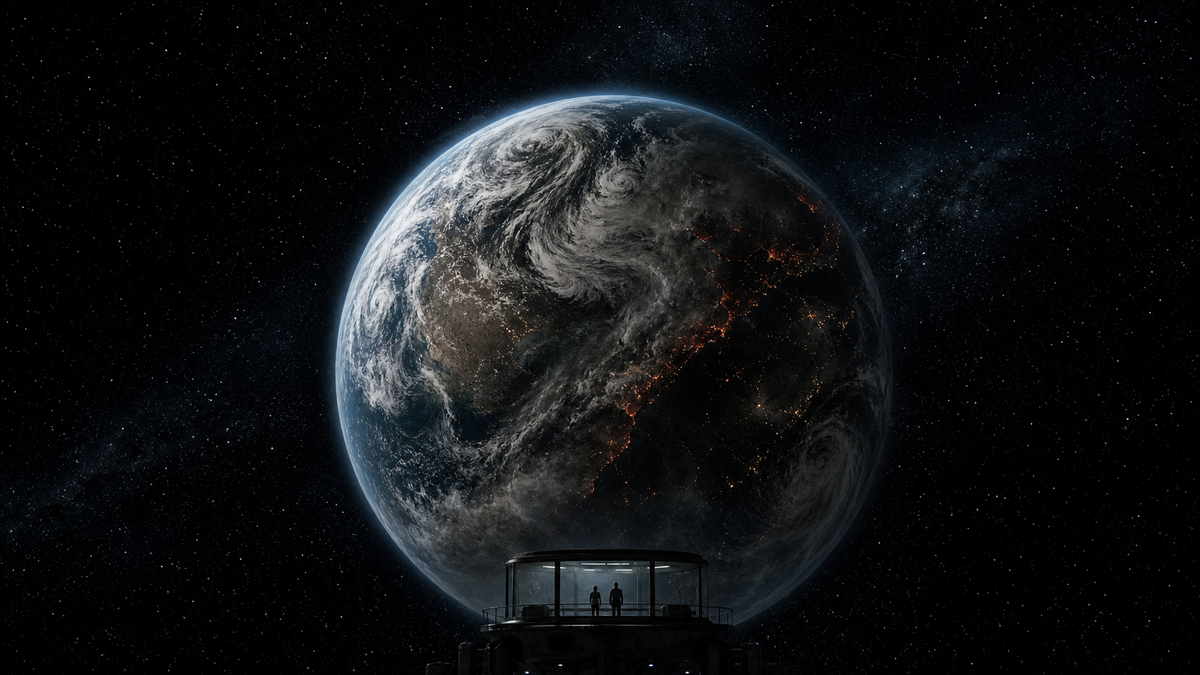
Earth did not fall. This point should not need stating, but the first public reader of my manuscript asked whether the title referred to an orbital change, and an alarming number of educational summaries have since used a descending globe in their visual material. Earth remained where gravity and momentum had put it. What failed was the human world upon it, catastrophically enough that the settlements beyond it stopped receiving the authority, supply, knowledge and ordinary reassurance on which they had been built.
The people on Luna saw the event first because light reached them first. Mars learned later. Ceres waited longer still, receiving not the event but messages about the event, followed by corrections to the messages, followed by cargo whose meaning had changed while it travelled. There was no single human moment in which everybody knew the same thing, which is awkward for memorial art and absolute bloody murder for a school timeline.
At E, something happened on Earth. A little later, instruments near Luna observed consequences. Later still, people elsewhere received whatever had been transmitted before systems, authorities, or people ceased transmitting it. A government might still be speaking after a settlement had acted on the assumption that it was gone. An order might be authentic and useless. A clearance might be valid when issued and lethal when received.
History likes a clock. Earthfall supplied several, all correct about their own location and increasingly argumentative in company. I began to explain the created, transmitted, received and acted-on clocks to Tove. She stopped me at the fourth.
“Three hundred words.”
“Time is not subordinate to your word limit.”
“My teacher is.”
The school had chosen the phrase personal account, which was interesting. Tove had not witnessed Earthfall. Neither had I. I was born on Ceres one hundred and eighty-six years after E. By that time, the first emergency orders had become constitutional footnotes, and several pieces of temporary equipment had acquired heritage protection.
I have never stood on Earth or seen an open sky, except as recorded light arranged on a surface that I knew, at all times, had wiring behind it. I have never experienced weather unless one counts a ventilation fault in the Spine, and Facilities does not. Their report called it unplanned cross-volume circulation, which is what happens when a draught acquires a pension.
Yet Earth is in my tea, which is usually too cold; in the language I use to complain about it; in the law under which the complaint is assigned a response interval; in the rosemary plant on my desk; in the pressure mathematics keeping the office from becoming briefly educational. This is what an origin becomes after it is unreachable: not a memory, but an inheritance distributed through ordinary things.
“Can I write that?” Tove asked.
“Which part?”
“The tea.”
“I would prefer you didn’t.”
She entered it, including the temperature.
• • •
The rosemary plant is called Unreliable Witness. It was grown from an archive seed line and has been dying for six years without completing the work. Yeva, who maintains crop diversity for a living, has offered assistance. I have declined because there are boundaries even loving partners should respect, and one of them is the right to fail independently at small-scale cultivation.
Yeva says this is not a boundary. The plant has not expressed a view in an admissible form, although its leaves have begun voting with their feet.
Tove pulled the loose chair towards my desk and looked at the three oldest Earthfall bundles on the display. The Lunar bundle was marked by source clock. The Martian bundle by jurisdiction and use history. The Ceres bundle by arrival state, which was a polite term for several hundred years of argument waiting in a docking queue.
“Who is the main person?” she asked.
“There isn’t one.”
“There has to be.”
“Why?”
“Otherwise it’s not a story.”
Here we reached the difficulty that produced my books. I had spent years telling public audiences that history did not have protagonists, only to discover that this was both ethically serious and a rotten way to keep them awake after lunch.
The public record preferred founders. A tug commander who broke an authorised hold to help capture a rescue transfer. An ombud who created a temporary category because people were physically present where the system had no noun for them. A scientist who released evidence before authority had caught up with observation. Later summaries placed one face above each event and called the arrangement clarity.
The machines preferred totals: eighty-six declared passengers, one hundred and three occupied restraints observed at loading, one hundred and nineteen people in the final rescue transfer, six Ceres frames and twenty-seven passengers assigned onward. Every number was useful. None could tell you whether a particular child still had her purple water bottle, whether a crew member had agreed to the next manoeuvre, or which maintenance job would be delayed because a berth had been given to somebody arriving alive.
People ask why the tug pilot did not simply rescue everyone, as though everyone were a mass category recognised by a vehicle. They ask why the ombud did not declare permanent safety, as though a declaration could inflate a pressure volume. They ask why the scientist did not wait for certainty, then object that the warning came late.
These are not foolish questions. I used to treat them as foolish questions, which was efficient, professionally gratifying and wrong. The archive had made the pressure legible to me and not to them. That failure belonged to the archive’s keeper, who had apparently been standing beside the shelves congratulating himself on their arrangement.
I told Tove about Ren Kovač in the tug Lark, working with measured mass rather than the declaration on her screen. I told her about Yara Chen keeping people legally present without pretending she had made room for them. I told her about Imani Sayeed separating what instruments had seen from what public authorities were still prepared to say.
“So three main people,” Tove said.
“Three principal Lunar viewpoints.”
“That means yes in archive.”
“It does not.”
She entered three names while maintaining eye contact. I have interviewed ministers with less command of a room.
• • •
At 08:47 the office floor changed pitch as freight moved beneath Intake 7-B. The optical reader on my desk brightened and completed a damaged-file comparison it had resisted for two days.
Facilities do not recognise this correlation. They have also requested that I stop conducting resonance trials without a maintenance protocol. I have complied in the sense that I no longer use the word trials and have stopped sending them the results.
The recovered file was a forty-seven-second Earth weather recording: rain on leaves, tyres on a wet road and thunder delayed by distance. It had no direct relevance to Tove’s assignment. I played it anyway. This was the straying-off-topic portion of the morning. I identify it because editors have informed me that recognition is the first stage of removal and I like them to know I saw the knife.
Nothing happens in the recording. Water falls through open air. A vehicle passes. Somewhere near the end, a door opens, and a person says four seconds of unresolved speech. Eleven enhancement passes have produced eleven sentences, all plausible and none reliable. I retain them as examples of technology becoming confident in a room where confidence was not invited.
Tove listened twice. “They let water fall outside?”
“Constantly.”
“Clean water?”
“Not in the sense you mean.”
“And it hit the road?”
“Among other things.”
“On purpose?”
“Weather had a broad operational mandate.”
She listened a third time, leaning close to the speaker as though proximity might turn water into a sensible use of resources.
For those born under pressure, Earth’s extravagance can sound fictional. Oceans uncovered. Air without a volume allocation. Water falling across roads, fields, roofs and people who had not booked it. There were places where the atmosphere ruined a picnic, and nobody opened an inquiry.
Earthfall was not terrible because humanity lost perfection. Earth had never offered that. It was terrible because an entire living scale vanished from reach, and every settlement discovered how much of its independence had been a timetable with Earth at the other end.
Luna could see the absence. Mars could measure supplies against renewal. Ceres could wait for what had already been spent elsewhere. Between them moved the altered carrier Godwit: people, sealed frames, opened materials, objections, copies, substitutions and promises that became less accurate with every honest use.
The vessel is often described as a lifeline, but a lifeline implies a secure hand holding the other end. There was no secure hand. There were only people passing capacity onwards and recording, when they were careful, what the passing had cost.
Tove paused the rain before the unresolved voice. “Were they all dead?”
I knew which answer the archive required: the archive does not establish the fate of the speaker. I also knew which answer my daughter had asked for.
“I don’t know,” I said.
No qualification followed. This took more effort than it should have. She let the final four seconds play, and we listened to a dead world fail to finish one perfectly ordinary sentence.
• • •
“What happened after?” Tove asked.
“After which part?”
She waited with the profound patience children reserve for adults who are making a simple question worse.
“People worked,” I said. This is not the dramatic answer, but drama has never repaired a scrubber.
On Luna they found berths, air, custody, medicine and manoeuvre margins that could not accommodate every claim placed upon them. On Mars they opened what had been promised elsewhere because a biological emergency did not care about title, then preserved the use, the objection and the burden of the substitute. On Ceres they received people and cargo without pretending acknowledgement meant acceptance. Workers checked routes. Modellers published assumptions. Passengers refused to let one adult’s signature become thirteen people’s consent.
Nobody founded the Heliocene in a room. The name came later, from historians, governments and publishers who find an era easier to shelve once the people inside it have finished being frightened. The people in the first records were trying to complete a burn, close a hatch, correct a list, protect a crop line and make sure a child’s medicine remained attached to the child rather than disappearing into cargo.
That was the beginning: not the name, but the work.
Tove read her draft. It had reached four hundred and twelve words, including the tea.
“You have exceeded the limit,” I said.
“You talked.”
“That is not recognised as a source of authorship.”
“It is in this house.”
She cut the clocks, retained the rain and removed two sentences I had considered structurally essential. Then she wrote a new opening:
Earthfall began when Earth stopped being a place the other human worlds could ask for help.
I wanted to amend worlds to settlements. Luna was not a world. Ceres was not, in the planetary sense, and Mars was a grievance with weather a planetary jurisdiction. My hand moved towards the slate, then stopped. Her word worlds were doing human work rather than astronomical work. This distinction is permitted, although I would prefer it not become habitual.
At 09:03 she submitted 296 words.
“Will it do?” she asked.
It was incomplete. It omitted the first observation package, every message clock, the Lark’s capture geometry, the legal expiry chain, Martian renewal horizons, the four sealed Ceres frames and the entire dispute over whether a record could travel without carrying command. It included a child listening to rain she had never stood beneath.
“Yes,” I said.
She packed the slate. At the door she stopped and looked towards the desk. “Your plant is dead.”
“The record does not support that conclusion.”
A leaf detached, crossed the desk in Ceres gravity and landed on the school assignment she had left open for my review. Tove looked at the leaf, then at me.
“You can add a correction,” she said, and went to class.
I logged the plant’s condition as materially revised, replayed the unresolved four seconds, and began the introduction HelioPress had requested six months earlier—maximum length: eight hundred words.
I have appealed. The appeal is concise, by my standards, and has so far required two attachments.
— R.C. Fenwick
Ceres Knowledge Archive
As of the last correction