Thirteen People in a One-Person Field
In this Earthfall story, Noor Basra refuses to let a broken evacuation record reduce twelve children—and their care—to one person’s field.
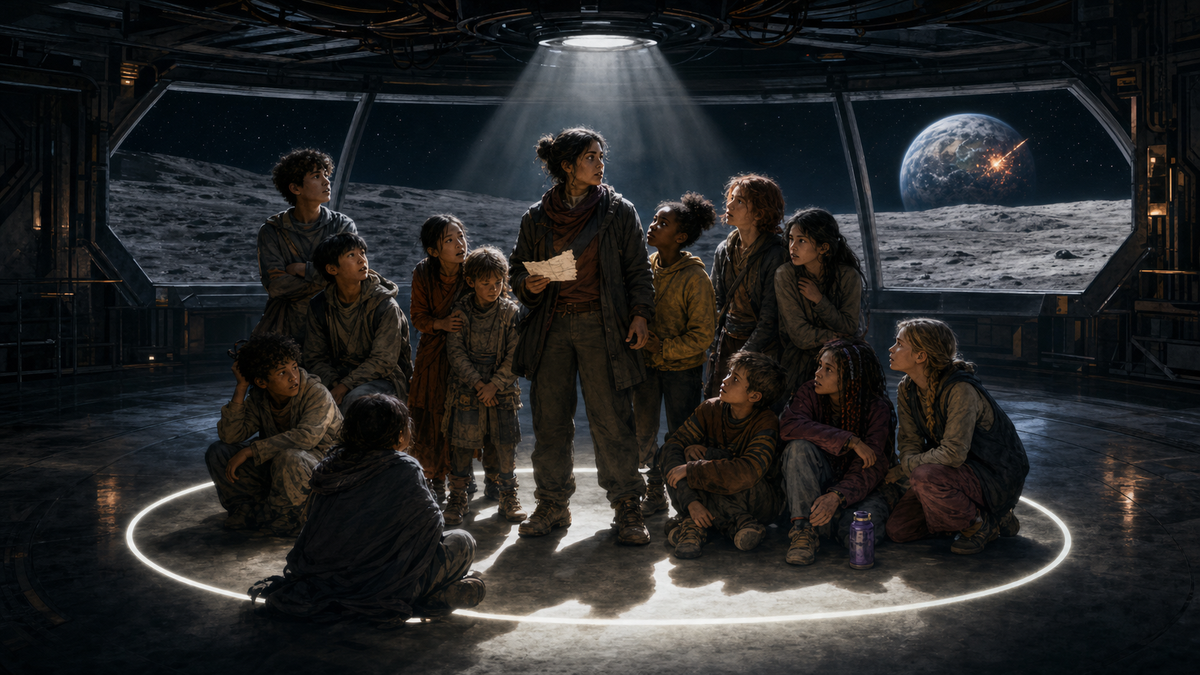
Noor Basra crossed three jurisdictions with twelve children, one surviving slip and no intention of becoming a plural noun.
The Earthfall Record · EF-S05 · Luna to Mars to Ceres
• • •
The surviving Lunar slip has a corner missing. It carries eleven observed names, four allergy notes and two uncertainties. Later records establish a twelve-child care cluster, but they do not establish whether both children held in a separate medical-room record were already among the eleven.
This does not make the slip the first or only list. I mention the distinction because archives are very good at turning the earliest thing we kept into the first thing that happened. The difference has produced several celebrated discoveries, two constitutional misunderstandings and an entire school of historical commentary that might have benefited from opening a drawer.
The paper belonged to Noor Basra. Its image survived through Lunar custody and later carrier records, with the missing corner remaining commendably missing despite several systems offering to reconstruct it. Every reconstruction produced a complete shape and slightly different content. This is the sort of technical confidence that makes a historian consider another profession, although I have reviewed the alternatives and most involve meetings.
The list was made in a waiting lounge on Luna thirteen days before E. Earth was still speaking. The clearances were green. The waiting category was not.
• • •
Noor was a teacher from Earth. That fact encouraged later writers to make her calm, because later writers have curious ideas about teachers and have apparently never watched one prevent fourteen children from improving a public address system.
The record does not establish calm. It establishes work. Noor counted, asked names, marked allergies and retained uncertainty. When a later boarding field asked for the adult contact, it received Noor because the record would not accept twelve separate relationships, unresolved family links and the possibility that the correct adult was not in the room.
The system accepted Noor Basra and copied her into each child’s record. This solved the form. The children remained more complicated.
One of the girls tugged Noor’s sleeve and asked whether the purple water bottle counted in a colour game. Noor said it did not, pending appeal. The girl accepted this, which is more confidence than most adults place in reviewable procedure.
The bottle matters because the game happened while offices were arguing over categories and Yara Chen was making another list of the children spending the day in somebody else’s care. The children were not symbols of uncertainty. They were bored, thirsty and rearranging the rules of a lesson.
There are moments when the record’s incompleteness feels indecent. Completing it ourselves would be worse, however good the reconstructed corner looks on a display.
• • •
Two hundred years later, Petra’s trainee brought me a corrected relationship table. I had rejected her first table because it used carer where the Lunar record said adult contact. These terms overlap in ordinary speech and diverge the moment an institution can use one person’s signature for somebody else.
She replaced the term, added the source limitation and returned the file. I rejected it again.
“Why?” she asked.
This occurred at 10:06 in Intake 7-B. The tea had reached the temperature at which it retained the colour of tea while abandoning every other obligation. Freight was moving below the floor. My optical reader had accepted a damaged carrier, rejected its index and begun making a sound associated in older manuals with an alignment fault and in my office with Tuesday.
None of this caused my answer. It merely provided an audience and several excuses I would later have the decency not to use.
“You have treated the Basra list as complete,” I said.
“I marked it surviving, not complete.”
“Your note calls it the child list.”
“It is a child list.”
“It may not be the only contemporaneous list.”
“I did not call it the only one.”
She had not. I knew this before she finished speaking. Accuracy presented an opportunity for repair. Temper found a narrower door.
“If a later reader can misunderstand the label, the label is insufficient.”
She stood very still. “A later reader can misunderstand anything.”
“That does not remove our duty.”
“No,” she said. “It gives you permanent employment.”
This was a good line. I did not enjoy it. She took the table and went back upstairs while the optical reader made its Tuesday noise.
“Not now,” I told it.
The reader, unlike the trainee, had no reason to care about my tone. That did not make the tone less bloody obvious in the room.
• • •
At E plus approximately eight hours, the Lunar waiting records stopped being waiting records. They became rescue records, custody records, accommodation counts and arguments about whether a human being could be physically present in a place whose software denied that they had arrived.
Noor and the children entered the rescue transfer among one hundred and nineteen people.
The declared passenger count was lower. The occupied-restraint observation was higher. The final physical count was higher again.
No fraud is required to produce these numbers. One system counted declared passengers. Another counted restraints under load. A third counted the people who had to breathe after docking. Each field did what it had been designed to do. The emergency lived between them.
The Lunar authorities needed a responsible adult for the twelve children because responsible adults are administratively portable. They can be placed in a box, attached to a case and invited to sign where indicated. Noor was portable in a strictly physical sense. Her authority was not.
Yara Chen’s temporary custody instrument kept the group legally present without claiming that Noor owned the children, represented every missing relation or could consent to every later risk on their behalf. It had an expiry. It preserved review. It was narrow because broad emergency powers have a tendency to survive the emergency and acquire stationery.
The distinction travelled badly. The people travelled better. They left Luna aboard Godwit with passengers, crew, archive copies, Ceres-bound frames and the accumulated consequences of a rescue that had used capacity intended for somewhere else.
The ship did not carry a clean victory. It carried people alive. These are not the same category, although public monuments remain keen to merge them because stone has no field for downstream cost.
• • •
Mars received Godwit at E plus 206 days. By then, the field containing Noor’s name had become an inheritance.
Her Lunar status was copied into a Martian intake layer. The twelve children appeared beneath one adult contact, and one adult contact became, through an entirely respectable sequence of imports, the person authorised to decide for thirteen.
Nothing was forged. Nobody sat in a dark office and plotted the abolition of childhood personhood. A database found an occupied field and, like a committee finding an old mandate, became ambitious.
Noor refused the ambition. She signed for herself. She confirmed that the children would stay together.
She did not sign their separate assent, refusal, medical disclosure or later travel authority. Martian officials created additional routes because the existing route was wrong. This required more work, more time and the public admission that the imported record had confused care with ownership.
Mars handled the correction competently. I note this without enthusiasm and retain it because temperament is not a recognised standard of evidence, however much nicer the form would look with one.
The Martian record also preserves Noor looking away from a camera towards somebody beyond its narrow field before saying, “The children stay together.”
The sentence is often quoted as an assertion of authority. The surrounding exchange makes it a limit on authority. She did not say I decide for them. She said what the proposed separation would not do.
This is Noor’s method throughout the record. She does not make uncertainty disappear. She makes it possible to work without pretending it has disappeared.
Names remain uncertain. Relationships remain incomplete. Everybody still has to eat, and the system still prefers one contact field because thirteen conversations take longer.
• • •
At 11:31 I reopened the trainee’s table. Her source field read:
SURVIVING WAITING-LOUNGE SLIP ATTRIBUTED TO NOOR BASRA
Uniqueness not established. Eleven observed names, four allergies and two uncertainties; relation to two medical-room records unresolved.
This was correct. Her relationship field read:
Adult contact recorded for twelve children. Separate family authority not established.
Also correct. Her interpretive note read:
The list made the children individually findable across later record systems without making Basra their universal proxy.
This was not a claim that the list was complete. It was, annoyingly, the precise point.
I had corrected her in front of the room after she had already corrected the file. I had made accuracy into punishment, which is what poor teachers do when they mistake their discomfort for a standard.
There is a proper form for this situation. It has four fields: act, effect, responsibility and change. No field is provided for the explanation that one’s tea was poor.
I went upstairs. On the way, I assembled three versions of the apology. The first explained too much. The second sounded as though I expected praise for noticing what I had done. The third began with if. I discarded all three before reaching Petra’s section, which spared everyone a truly exhausting piece of personal growth.
Petra’s trainee was reviewing a pressure-court bundle with two other apprentices. I asked to speak with her and then did so where the first correction had occurred. Petra glanced up from another table, saw my face and very deliberately returned to her work.
“I rejected your table after you had preserved the exact limitation I said was missing,” I told her. “I corrected you in front of the room and used uncertainty as though it belonged to me. I made accurate work feel unsafe to submit. I am sorry. Your table should pass with the wording you gave it.”
She looked at me. I did not add that my concern had been methodologically valid in the abstract. An apology followed by a source defence is simply an argument wearing indoor shoes.
“All right,” she said.
It was not absolution, friendship or a certificate of improved character. It was sufficient authority to proceed. I approved the table and left her to decide what, if anything, would be repaired beyond the file.
• • •
Seventeen non-crew travellers consented to leave Mars for Ceres. Noor and the twelve children were thirteen of them. The number is simple. The authority beneath it was not.
Each person retained a route for assent, refusal and review appropriate to what the record could establish. The thirteen-person care cluster remained together without becoming one legal organism. Four other competence travellers made their own decisions. Six crew operated the ship.
Twenty-three people departed. The outbound record could have represented this as one crew, one passenger group and one responsible adult. It would have been shorter. It would also have moved twelve people into a subordinate clause.
Instead, the Godwit packet carried the separate records. It reached Ceres at E plus 798 days.
Ceres acknowledged the arrival. It did not thereby accept refuge, title, cargo claims, political inheritance or the pleasing idea that a difficult journey becomes morally simple at docking.
On the ship, Noor turned a quarantine display into what she called a weather board. Green meant one occupied-zone condition. Amber meant another. Purple carried questions the formal notice had omitted. The children’s version was shorter than the official one and, as often happens, contained more of the information required to live through it.
Later, a transfer record again tried to treat Noor as the adult noun with twelve dependent adjectives.
“Transfer is not authorised,” she said.
Four words. The system had several thousand. The transfer stopped, which is why concise language should not be confused with small authority.
This does not make Noor the sole rescuer of twelve children across three worlds. We do not know every person who helped, every list that existed, every refusal that altered a route or every private act of care that left no administrative shadow.
It establishes something narrower and, to my mind, more demanding: whenever a system made Noor large enough to erase the people beside her, she made herself smaller in the record and put them back.
• • •
The approved relationship table now contains thirteen linked person records: Noor Basra and the twelve children for whom she was the recorded adult contact.
The links preserve uncertainty. They do not manufacture family connections. They do not disclose restricted medical details. They do not claim the surviving list was unique. They do not make care less real because ownership is absent.
The waiting-lounge slip remains incomplete. Its missing corner has survived every migration. The eleven observed names remain eleven. The two medical-room records remain uncertain rather than being pressed into a tidier total. Later systems establish twelve children in Noor’s care cluster, but the archive does not repair the earlier gap merely because the later count is known.
The purple water bottle stays where the record places it: in a Lunar game, returned to its owner before the lounge emptied. Ordinary objects are allowed to remain ordinary. Historians dislike this because ordinary objects refuse promotion.
I sent the approved table back to Petra’s trainee with no further comment. Five minutes later she returned it. For a difficult moment, I believed she had found another error.
She had added a relationship-display test. When a public user selected the cluster, the interface no longer placed twelve names beneath Noor’s in smaller type. It displayed thirteen names at the same level, with the known links between them and the unknown links left open. The arrangement occupied more space. Human beings often do. I approved that too.
At the end of the cycle, the optical reader completed its damaged-file comparison. It had recovered no new name from the slip. It had, however, offered two high-confidence completions for marks at the damaged edge. Each would have converted an uncertainty into a person the surviving record did not support.
I rejected both and restored the unresolved field.
Some future reader may find that frustrating. They are welcome to come down to Intake 7-B and explain which child they would prefer me to invent. Office hours are posted. The queue is vindictive. Bring tea—or, if you mean to defend automated certainty, something stronger.
— R.C. Fenwick
Ceres Knowledge Archive
As of the last correction